
Insulation for Boston's triple-deckers, Victorians and streetcar suburbs
Spray Foam Insulation in Boston, MA
Air sealing, spray foam and dense-pack for older homes across Boston and the inner suburbs.
- Free on-site estimates in Boston and the inner suburbs
- Written quotes that list material, thickness and R-value for every area
- Old wiring, vermiculite and moisture flagged before any work is planned
Older Homes, Harbor Wind and Real Winters
Spray foam insulation in Boston usually goes into houses that were built long before anyone sealed a wall. Much of the city's housing went up as neighborhoods like Dorchester, Jamaica Plain and Brighton grew from farm towns into streetcar suburbs after they joined Boston in the 1870s. Wikipedia's climate summary lists 49.2 inches of snow a season, mostly from mid-November to early April, and notes the city is prone to nor'easters. Old framing, wind off the harbor and steady winter snow add up to drafty rooms and ice dams. We seal the leaks and insulate the spaces that need it, with closed-cell or open-cell foam where foam fits and dense-pack or loose fill where they do the job for less.
Three building types, three plans
Triple-deckers and two-families. Stacked units with porches on the front, a shallow attic or low-slope roof on top, and a basement with a bare rim joist on the bottom. The top unit overheats in summer and the first floor is drafty in winter. We usually plan roof-cavity insulation, wall dense-pack and rim joist foam together.
Victorians and older singles. Balloon framing lets air rise from the basement to the attic inside the walls. Steep roofs, dormers and turrets leave odd attic pockets. Foam at the sill and top plate cuts off that air path, and dense-pack fills the walls.
Capes and colonials. In Arlington, Medford, Quincy, West Roxbury and Newton, the 20th-century houses leak at kneewalls, attic hatches, recessed lights and rooms over porches or garages.
What the Massachusetts code calls for
The state stretch energy code says plainly that Massachusetts is in Climate Zone 5A. The Insulation Institute's summary of that code, based on the 2021 IECC and in effect from January 1, 2023, lists R-60 for ceilings, R-30 or R-20 plus R-5 continuous (among other options) for wood-frame walls, and R-19 or R-15 continuous for basement walls. Those apply to new construction and additions. For an existing house they are a useful target; most older Boston attics fall well short.
Closed cell vs open cell
Open-cell foam is soft, expands to fill odd cavities and stops air, at R-3.5 to R-3.7 per inch in HomeGuide's numbers. It lets some vapor through. Closed-cell foam is dense and rigid, R-5 to R-7 per inch, and at normal thickness it slows vapor and resists water. In Boston, closed-cell is the usual choice for rim joists, brick and stone foundation walls, the underside of low-slope roofs and floors over open porches. Open-cell fits interior cavities and some roof assemblies where the vapor side is handled another way.
Foam is not always the right buy. On an open attic floor, sealing the gaps and blowing cellulose to depth gets close to R-60 for much less. In closed plaster walls, dense-pack cellulose is usually more practical than foam. We say which fits each part of your house.
Questions to ask spray foam insulation contractors
When you talk to insulation contractors or spray foam insulation companies in Boston, ask what gets sealed before any insulation goes in, which foam goes where and how thick, and what R-value is written on the quote. Ask how they handle knob-and-tube wiring, vermiculite and plaster. Ask how a multi-unit job is scheduled and how long each unit needs to be empty after spraying; HomeGuide's guidance is at least 24 hours. Ask whether the quote lists each area separately so you can compare.
Spray foam insulation cost
HomeGuide's 2026 guide puts installed spray foam at $1.50 to $5.00 per square foot: $1.50 to $3.50 for open-cell, $3.00 to $5.00 for closed-cell. It lists rim joists at $2,000 to $2,500 and whole houses at $8,000 to $20,000, and says many installers have a $1,000 to $2,000 minimum. Fixr lists foam in existing walls at $3.15 to $7.50 per square foot. Those are national numbers. In Boston, access is often the local cost driver: narrow stairs, finished attic rooms, porches tied into the frame and parking for equipment on dense streets. Your written estimate is the price.
Mass Save and city help
Mass Save lists no-cost Home Energy Assessments for one- to four-unit homes, which covers most triple-deckers and two-families, and 75 to 100 percent off approved insulation improvements. Boston's own guidance on insulation barriers notes a Mass Save barrier incentive of up to $7,000 for income-verified households and a 0% HEAT Loan for fixing problems like knob-and-tube wiring or vermiculite before insulating. Somerville runs Save Energy Somerville with its own microgrants for some rental units. Start with the assessment if you want those incentives.
Common Questions
Can you use spray foam to insulate walls?
Yes, when the walls are open during a remodel. Foam fills the stud bays and seals them in one step. For closed plaster walls, dense-pack cellulose blown through small holes is usually the more practical choice.
What can spray foam have the highest R-value?
Closed-cell foam, at about R-5 to R-7 per inch according to HomeGuide, compared with R-3.5 to R-3.7 for open-cell. That matters in shallow rafters and rim joists. On an open attic floor, loose fill reaches R-60 for less.
What's the average cost per square foot for spray foam insulation?
HomeGuide's 2026 range is $1.50 to $5.00 per square foot installed; Fixr lists $3.15 to $7.50 for existing walls. Access and building type change the total in Boston. Your written estimate is the price.
What material is spray foam insulation?
It is a two-part polyurethane product. The two liquids mix at the spray gun, react, and expand into foam that bonds to the surface. Open-cell and closed-cell versions differ in density, R-value per inch and how they handle vapor.
Does Mass Save cover spray foam?
Mass Save lists 75 to 100 percent off approved insulation improvements after its no-cost assessment, and those incentives apply to work approved through the program. Start with the assessment; for work outside it, we price directly.
Can a triple-decker be insulated one unit at a time?
Yes, but the building works as a whole. Air entering at the basement exits through the top floor. We will tell you what each floor needs, even if you start with one.
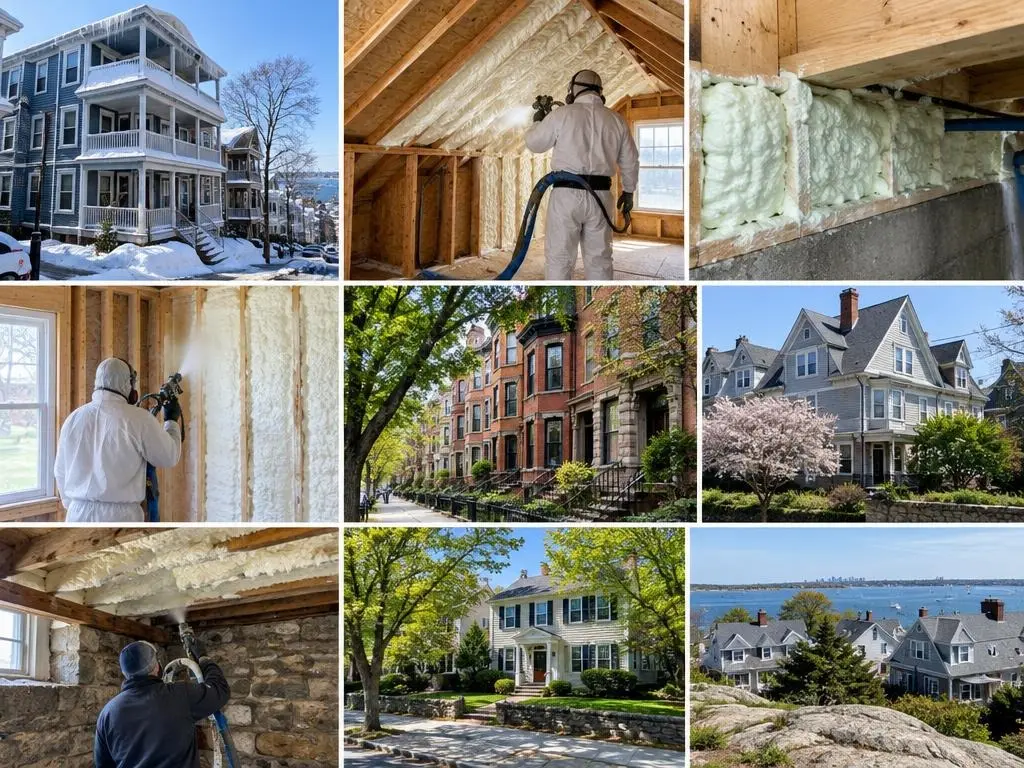
Insulation Services in Greater Boston
Six services shaped around Boston's older housing, from triple-deckers to mid-century Capes.
Spray Foam Insulation
Open-cell and closed-cell foam for rim joists, rooflines, porch floors and open walls.
Learn more →Triple-Decker & Multifamily Insulation
Whole-building plans for triple-deckers and two-families: roof, walls, porches and basement.
Learn more →Attic & Roofline Insulation
Attic floors, finished attic rooms, kneewalls and low-slope roofs sealed and insulated.
Learn more →Dense-Pack Wall Insulation
Cellulose packed into empty plaster walls through small holes, without gutting rooms.
Learn more →Rim Joist & Foundation Insulation
Closed-cell foam on sills, rim joists and brick or stone foundation walls.
Learn more →Old Insulation Removal
Clearing wet, soiled or failed insulation so the space can be sealed and redone.
Learn more →Neighborhoods and Towns We Serve
We work across Boston, including Dorchester, Jamaica Plain, Roslindale, West Roxbury and Brighton, and in the cities and towns around it: Cambridge, Somerville, Medford, Arlington, Watertown, Brookline and Newton to the west and north, and Quincy, Milton and Dedham to the south. Streetcar-era neighborhoods hold the most triple-deckers and two-families, while Brookline, Newton, Arlington and West Roxbury lean toward single-family homes. Each page covers what is different there.
- Spray Foam Insulation in Boston, MA
- Spray Foam Insulation in Dorchester, MA
- Spray Foam Insulation in Jamaica Plain, MA
- Spray Foam Insulation in Roslindale, MA
- Spray Foam Insulation in West Roxbury, MA
- Spray Foam Insulation in Brighton, MA
- Spray Foam Insulation in Cambridge, MA
- Spray Foam Insulation in Somerville, MA
- Spray Foam Insulation in Brookline, MA
- Spray Foam Insulation in Newton, MA
- Spray Foam Insulation in Watertown, MA
- Spray Foam Insulation in Arlington, MA
- Spray Foam Insulation in Medford, MA
- Spray Foam Insulation in Quincy, MA
- Spray Foam Insulation in Milton, MA
- Spray Foam Insulation in Dedham, MA
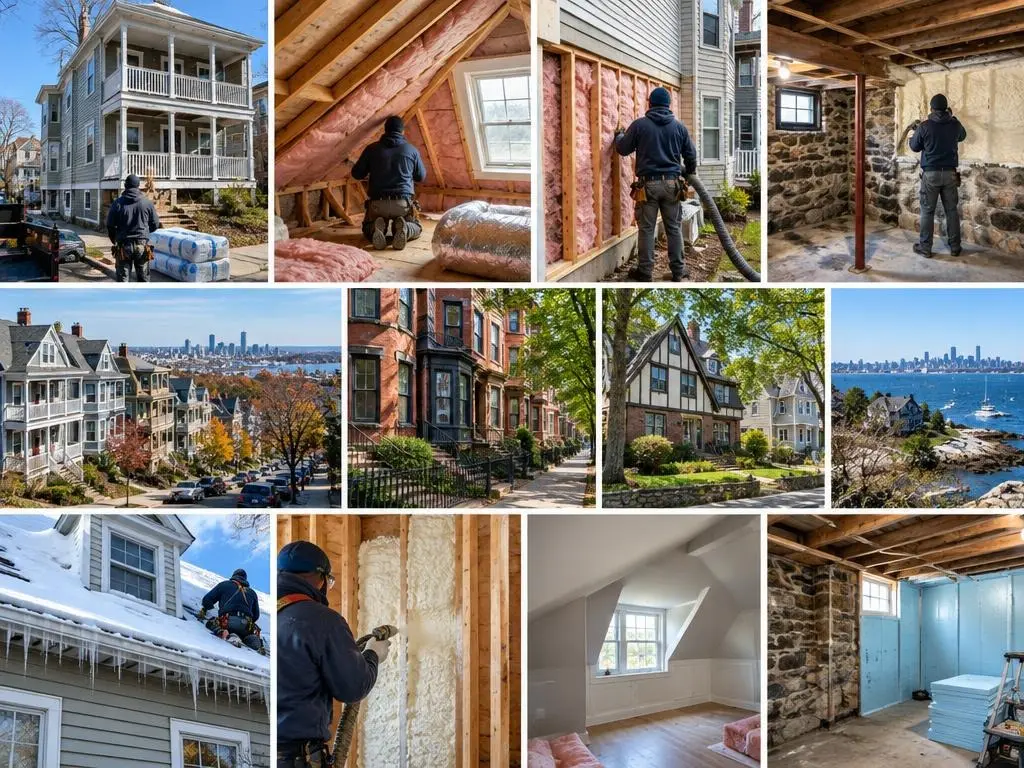
Why Homeowners Call Boston Spray Foam Insulation
Built for old houses
We plan around plaster, balloon framing, porches and stone foundations.
Seal before we insulate
Sills, top plates, chases and penetrations are sealed first.
Barriers named early
Live old wiring, vermiculite and leaks are pointed out before work is scheduled.
Quotes you can compare
Material, thickness, R-value and price for each area, in writing.
Get a Spray Foam Insulation Estimate in Boston
Book a free visit and get a written, area-by-area quote.